
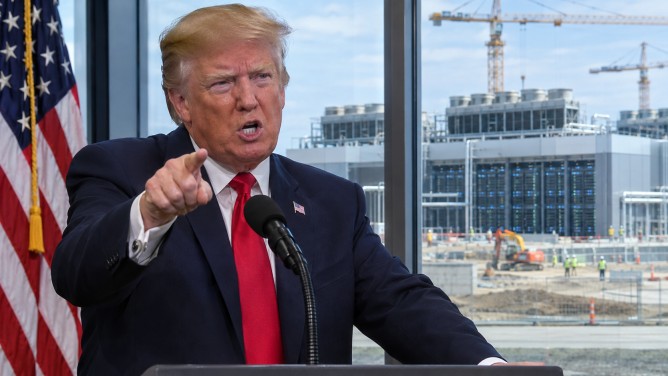
President Donald Trump has announced a plan to impose significant taxes on American companies that construct data centers overseas. In a recent press conference at the White House following his trip to Asia, Trump emphasized that such measures are intended to bolster the United States’ artificial intelligence (AI) industry and enhance its competitive edge against China.
Trump’s proposal comes amid ongoing efforts by the U.S. government to solidify its standing in the global AI race and to prevent China from gaining access to advanced semiconductor technology. The administration has already implemented stricter controls on the export of advanced AI chips to certain Southeast Asian countries, fearing that Chinese companies might obtain restricted technology through international data centers.
Data centers are crucial for the development and operation of AI systems, as they provide the necessary computing power. Major American firms such as Equinix and Digital Realty currently operate numerous data centers internationally. However, Trump’s proposed taxes aim to encourage these companies to focus their data center investments within the U.S., thereby supporting domestic infrastructure development.
While the intention is to strengthen the U.S. AI sector, the potential financial penalties could impact American companies’ global expansion strategies. Building data centers closer to end-users often reduces latency, enhances service performance, and lowers data transmission costs. The proposed restrictions could introduce uncertainty in the technology industry as companies reassess their international operations.
Trump’s announcement underscores his administration’s broader strategy of promoting domestic technological investments while limiting China’s access to advanced AI capabilities. This approach reflects a commitment to expanding the U.S. computing infrastructure and maintaining a competitive edge in the ever-evolving field of artificial intelligence.